• Home/Blog
  • Podcast
  • About
    • Contact
  • Portfolio
    • Advertising
    • Strategy
    • Taglines
    • Filmwork
  • Subscribe
  • search

Amy Swift Crosby

the story is in the telling

Small Business

Contact High.

October 10, 2017 · By Amy Swift Crosby

Airplane metaphors abound, but basically, don't get stuck up here.

At a time when being acknowledged feels like the exception rather than the norm, opportunities to connect with your people are everywhere. Giving attention, in the right way, is like sending an emotional gift certificate.
 
Most of us reading (and writing) this blog grew up on autoresponders.

They were invented solely to help businesses stay in touch, without all the heavy lifting of customer service and marketing spend. But decades later, these messages have lost any sense of real connection. At this point, they feel pretty canned. So while as owners, we appreciate their efficiencies, as consumers on the receiving end, our reaction is to hit delete.
 
Which is why, in 2017, it is (almost) extraordinary to hear directly from a small business owner. When an owner reaches out, herself, not in response to a complaint or as part of a PR strategy, but just because, it delivers a contact high — for both customer and owner. Sure it could be argued that an owner’s time would be better spent at the 30,000ft level, but the reality is that direct contact actually moves the dial.
 
Automation makes a lot of sense in a lot of cases. But unlike their bigger competitors, small business owners have the opportunity to cultivate real human connection with a customer or client. Of course you can program your CMS or email marketing campaign to regurgitate what you’re saying to every new customer or every transaction, even go as far as customizing communications with their first names — duh. But when people get a sincere/curious/thoughtful note from the face of a business, it goes a long way to plant the seeds for a lifelong relationship, one that will grow and deepen year after year, and a customer who will sing your praises to their tribe who trust her recommendations.
 
The cost is relatively small — minutes.
The win is proportionately big — years.
 
I’m not saying automation isn’t great and useful, but it creates a false reassurance that we’re connected to the people who buy our stuff.
 
Richard Branson once wrote me a personal note after I gave him a detailed (ahem!) review of his Virgin Atlantic first class service. They became a client, and I became a loyal customer.
 
If Branson can do it — so can we.
 
Here’s to saying hello for no reason. We can almost always learn something new by talking to the people who buy/read/follow or otherwise make it possible for us to be in business.

 

Big Life

Intentional Tension.

October 3, 2017 · By Amy Swift Crosby

The other afternoon, I struck up a conversation with a fifth grader, a friend of the family, about how school was going this year. She described something her teacher was doing prior to a test, that to me felt stressful. It doesn’t matter what it was as it relates to this story, but when I pressed her for an explanation, here’s what she said:

“Oh, she does it on purpose,” she told me as a matter of fact. “To create intentional tension.”

!!!

Of course, I lost my (metaphysical) marbles. Teaching fifth graders, who haven’t yet hit the apex of anxiety, how to practice being anxious, seemed nothing short of genius. And it got me thinking.

What if at an early age we set up a controlled environment, with skilled oversight, expressly designed to teach us how to speak up for ourselves (or others)? To express needs?

Put a different way, it would be a space in which to learn restraint and then reward, deliberately; to exist between discernment and persuasion and to experience different ways of managing and resolving a conflict. What if we practiced…having a “practice”… in preschool?

Rather than promoting kindness because it’s the right thing to do, which most schools (understandably) embrace, what if we designed highly controlled uncomfortable situations, to help kids navigate them — and make more informed choices – from the start?

If we can do a mock U.N. at school, why can’t we apply that to training for our most challenging emotions?

Practicing worst-case scenario may not replicate the exact experience a stressful event creates, but kids become adults. And adults have the power to create or destroy.

Tools don’t give us wiggle room… as much as options.
And we should have options… from the get go.

Practice, in this case, is a double entendre (my favorite happy accident):
It’s both the rehearsal we do in preparation for a future event, and the thing that grounds us in the here and now.

We know events will happen.
And we also know, all we have is now.

Big Life

Fanship.

September 19, 2017 · By Amy Swift Crosby

Like some of you, I operate in the feedback space, constantly and methodically evaluating what is working and what isn’t. But this post is about an entirely different sensation; being a goofy, unrestrained, unadulterated fan; being swept away in the perfection of a thing, and seeing it for all the good that it is.

As consumers, we need unapologetic fan moments more than ever. Having posted about being a Downseller (and wow there are a lot of you), this one is a confession about the value of falling in love – as a fan, follower or customer.

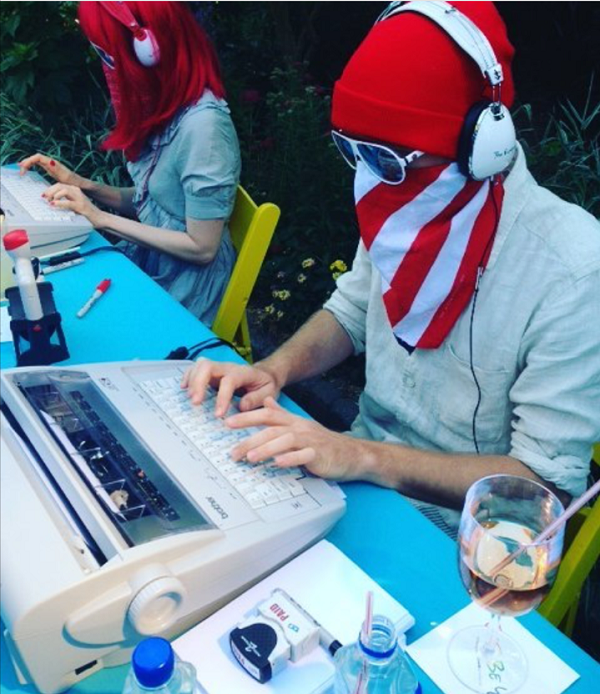
My own fan moment came recently at a party in Malibu, with the performance artist duo The Bumbys. Incognito in their red white and blue gear, behind electric typewriters, wearing noise-cancelling headphones, accompanied by their handler, they silently deploy “fair and honest appraisals” of party-goer’s appearances. Their astute, aspirational index-card write-ups are printed on the spot, and handed over after about two minutes of focused typing and hand proofing (and presumably observation, which you can’t really see from behind their sun glasses.)

I fell hard for Gill and Jill Bumby.

Conceptually, I want to be a Bumby. Giving prophetic, colorful, reassuring feedback to complete strangers, while in costume, describes my dream job.

But as a participant, standing there – vulnerable – staring down the barrel of someone else’s opinion, was initially unnerving. You’d think the appraisals would lean toward “honest” in a possibly snarky direction — but it was the opposite. Throughout the evening as we (guests) exchanged index cards, comparing our write-ups, the universal sentiment was heartening — each felt poetic, personal, and even better, strangely true! Imagine all the people they’ve assessed, walking around with these insightful, deftly nuanced self-approval ratings. #genius.

Being a fan means losing your suspension of disbelief, and letting a person, product or concept, steal you away from the expected. In its unique resonance, these experiences reassure us that something is very right in the world; A signpost, however infrequent, we all need.

As business owners, most of us aim for amazing, but acknowledge that it takes a lot of hard work/time/attention to elicit that effect. Which is why, when someone or something moves us intellectually, emotionally, spiritually (or all three,) we gotta lose the pretense of “mature” and “professional” and just bow down, and give it up, if we feel it.

I restrained myself from asking The Bumbys for an autograph, but did work up my courage for a photo. Couldn’t help it, and didn’t care. Losing our cool factor in exchange for earnest fanship is one of the last vestiges of our innocence.

Go ahead, write a love letter. It feels really good.

Respect to The Bumbys!

Big Life

Clive.

September 12, 2017 · By Amy Swift Crosby

Recent (very cheeky) work with Clive and a|c.

I’ve talked about singularity in this blog, as well as belonging, long-term relationships and the difference between good and great. I’ve obsessed over design (or the lack thereof) and extolled the power of words. All of these themes thundered through my chest as I learned that one of my longtime collaborators, Clive Piercy, the creative director of LA-based design shop Air Conditioned (a|c), had died after a year-long illness.
 
I met Clive, and his incredible team, about 13 years ago. He was sharp, dry, irreverent – utterly British, and in every way. In those early days, I was intimidated and, admittedly, completely out of my league. I quietly watched his design presentations, hoping my words would make it into his world, onto his radar — that I might matter to him someday. When they did, I saw how important the relationship between design and words is; and how this love affair can create fireworks for brands, stories and messaging. I’ve never looked back.
 
His idea-driven design introduced me to a new level of work — one I could never unsee, actually. He had a sharp tongue and critiqued my submissions more than praised them — but of course made them better. Clive had instincts that were rarely off base. a|c and his design leadership shaped my own filter and perspective. So much of what I know about this work comes from projects with Clive, Hilary, John and the team.
 
I’m good…because he was great.
We’ve lost one of the best.
 
I don’t think any of us (and there are so many) who count Clive among the most influential creatives in their lives, will soon walk into any meeting or read any brief without hearing Clive’s missives over their shoulder.
 
Count your teachers as your blessings, because they don’t always appear as such until they are no longer there to remind you that one of the reasons you do what you do, is to please them.
 
For more on Clive, a|c and the value of exceptional teams, read this post.

Big Life

Pause.

September 5, 2017 · By Amy Swift Crosby

@chrisbenidt

If I stop writing, will people forget about me? Or unsubscribe?
Will my ideas still be there when I return to them?
And (quietly), have I’ve wasted this opportunity by “taking a break”?
Or alternately, does is not matter…enough?

Isn’t it interesting to see what the mind does to sabotage an otherwise great idea.

These were a few of the fears swirling through me in late July as I contemplated ‘pressing pause’ on the blog – and work in general. As I pushed back clients to September in order to take an August hiatus, I also made space in my schedule by setting aside the blog for five weeks. But with that decision came much angst about the consequences of a pause.

So many of us are unknowingly enslaved by ‘the machine.’ Beyond just social media feeds, it’s the fear that if we pull back from our public identities, we may find ourselves adrift, unable to get back on course. It takes hard work to stay in the public conversation, whatever yours may be, and it takes an equal measure of confidence to step out of it now and then — and gaze upon the horizon ­— to go dark.

What I learned during this self-imposed break was that I didn’t suddenly lose my ability to have quality thoughts or publish meaningful words. Publishing a weekly blog forces me to take a point of view, and commit to ideas and questions that might otherwise slip through my fingers – unresolved. That’s it. Of course I love the endorphins that spark a domino effect of likes, forwards or replies. I’m as vulnerable as anyone to digital flattery. But just as it’s hard for a CEO to shut down email for two weeks, or for a pop star to give up Instagram for a month, or for a founder to get perspective via traveling sabbatical, so is it for each of us to pull back from what we do to make sure we know who we are — without those validations.

Is reinvention, or perspective, so daunting that we’d rather keep up the status quo — replying, submitting, authorizing and showing up — because stepping away may reveal a truth? And maybe that truth will involve change?

Intentional breaks have a purpose and a place, but so often when we don’t know what to do, it’s easier to be in action, than (what feels like) stillness. Maybe questioning the thing we think makes us “us” is the best way to disrupt what is at best an illusion, and at worst, a crutch that limits our real potential.

You are not your company.
You are not your book.
You are not your blog
You are not your feed.

Freedom = reclaiming the lever that has you believing that you are the sum of your marketing, persona, asset or deliverable.

Small Business

Millennialmania.

July 25, 2017 · By Amy Swift Crosby

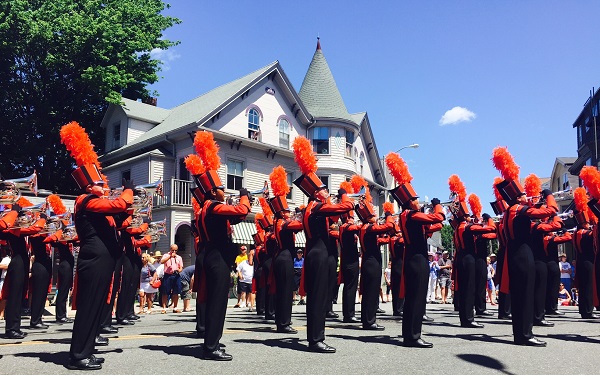
Parades, fanfare and applause. #calmdown

I can’t tell. Is the entire universe enamored with, or terrified of, millennials? Without question, they have emerged as the demographic most often mentioned in an initial phone call with a prospective client, and the last thing raised during a marketing meeting. It usually goes something like: “Make sure millennials will like it,” or “Let me run it by my daughter… she is a millennial.”

But what many of my collaborators and I actually hear, is the subtext of this conversation, which is: “OMG we are NOTHING without millennials! If this doesn’t appeal to millennials, we are doomed. Insignificant. Done.”

First, let’s calm down.  Millennials represent about one-quarter of the buying power according to retail analysts who are tracking these things (by the minute, it seems.) That leaves 75% of the rest of us who also have money and (actually) buy things.

Second, millennials may not be as exotic, omniscient, and powerful as we’ve made them out to be. Yes, they think differently and shop differently than a 60-year old consumer, but what they may really represent is a more honest and efficient approach to selling products or consuming content.

  • They don’t respond well to hype, over-selling or noise — neither do you.
  • They want to “buy from” not be “sold to.” So do you.
  • They want to know what their friends think. So do we, but we share over a conversation in-person as opposed to sharing online.
  • They buy from their devices, rather than their desktop. That’s becoming truer for all of us.
  • They want all of the information in a single sentence, or better yet — a hashtag. Secretly, you sort of agree.

See where I’m going? It may be that when it comes to being consumers, we really aren’t all that different. Yes, there are differences (I’m not discounting my retail people and their lengthy discourse on the subject) but millennials, and their short attention spans, have also contributed to creating efficiencies that are representative of most attention spans, not just theirs. After all is said and done, the result of our current obsession with them may actually end up being better, more transparent marketing.

See, when brands make big shifts in their businesses and make key marketing decisions in service to one demographic or trend, it has a limiting effect. It restricts quality thinking about how those people or topics will grow, change and evolve. Millennials will mature like all generations before them (we sincerely hope) and along with better work ethics and less entitled attitudes, will grow into people who think for themselves, rely less on peer input, and use the same devices the rest of us use to buy the stuff they want, at the right price, through the most efficient platforms, from the brands they trust. At that point we will welcome them to the 75% who feel the same way and do the same thing.

Does Gen Y matter? Sure.

But I caution us to stop glorifying their thinking to be more rarefied than it is. It may not look so different from what you also appreciate from the worlds’ marketing departments.

Funny, disarming, short-form, real, inspired, truthful, provocative — or — just on sale. Not so different.

#millenialsecretsrevealed

Newer Posts
Older Posts

[insta-gallery id=”1″]

About Me

photo of Amy Swift Crosby

I’m a brand strategist and copy writer. I mostly work with partner agencies or directly with the leadership or founding team at a brand. My primary mission is to connect design and messaging solutions to business missions. I work with start-ups and Fortune 500 companies, across beauty, hospitality, wellness/fitness, CPG and retail. This blog reflects my personal writing and explores our humanity – often as it relates to work, space, time and language. You can review my portfolio here or connect with me here.

Photo - Andrew Stiles

The Brandsmiths Podcast


Brand Strategists Hilary Laffer and Amy Swift Crosby tackle business questions with candid, (mostly) serious and definitely unscripted workshopping sessions. Guests – from small business owners to CEOs, executive directors and founders – bring their head-scratchers, hunches and conundrums to Hilary, the owner of a boutique creative agency in Los Angeles, and Amy, a copy writer.

Search Posts


Latest Posts

  • The Last Time.
  • Barefoot.
  • Mileage.
  • Everything.
  • Eddy.


Copyright 2025 Amy Swift Crosby