• Home/Blog
  • Podcast
  • About
    • Contact
  • Portfolio
    • Advertising
    • Strategy
    • Taglines
    • Filmwork
  • Subscribe
  • search

Amy Swift Crosby

the story is in the telling

Big Life

Zerrissenheit.

February 27, 2018 · By Amy Swift Crosby

When how it is says everything about how it isn’t.
When clarity obscures, and you can’t see the way.
When even the angst… has angst.

Zerrissenheit (German): Disunity, inner turmoil. Strife.

Whether a feeling is founded or not, useful or not, inner turmoil wreaks havoc. In the moment, the feeling is real, even if it conflicts with our sense of our highest selves, or even with the facts of a situation. It can be hard to rescue yourself.

When deeper worries come up in my own life, and so many of us are plagued with them lately, I’m surprised at how quickly and efficiently fear moves in to take over. The “what if’s” are catastrophic; the possibilities, dark and foreboding. While my exterior remains calm, inside I wonder where all these years of meditation, contemplation, belief…have gone. Shouldn’t I know how to not fall apart like this…by now?! (Read with all the judgment that question intends.)

But what I’ve noticed in myself (and others) is that while a kernel of faith or a regular practice of some type is the long game, it’s not usually what pulls me out of the dark in those moments riddled with acute anxiety. More often, the lifeline that appears in the most immediate sense is a wise being in my midst.

She says something like…

“Yes.
Same here.
I know.
And…”

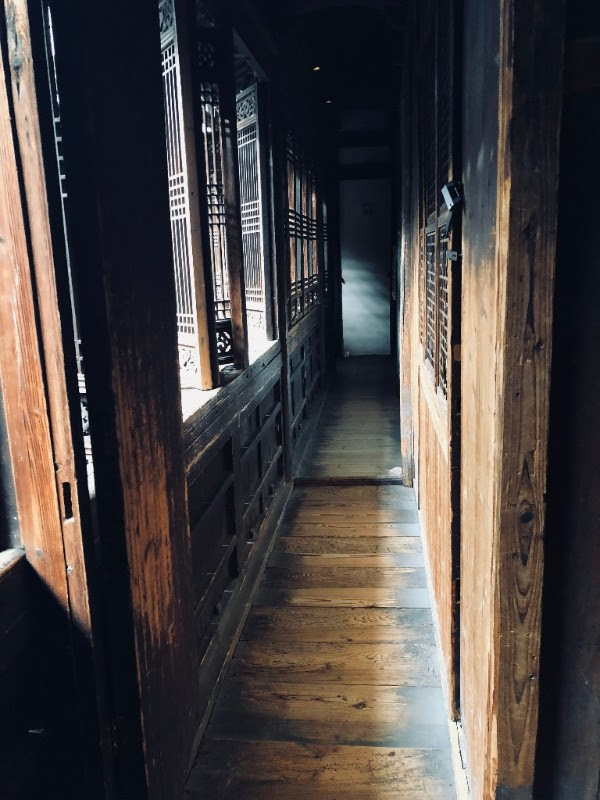
From here, the path tends to open up — a little light comes in. It’s usually just enough to start to see daylight in what can feel like a narrow hallway with walls closing in.

It isn’t a sign of failure that a long-held faith or other innate wisdom has failed. I can sometimes have a punishing view of this — as in — these are the moments where resilience should appear! Where is that ‘knowing’ when I need it most?

Rather, the embodiment of just the right voice at just the right time can be a living reminder of the potency of genuine human intervention — and a messenger from the very energetic force you’d hoped to tap within. Just because it isn’t coming from you, doesn’t mean it isn’t present.

We’ve all been there.
And will be there again.
Sometimes you’re the wise one; others the lost.

Being one… does not preclude being the other.
Most of us are both.
 

Small Towns

Malls.

February 20, 2018 · By Amy Swift Crosby

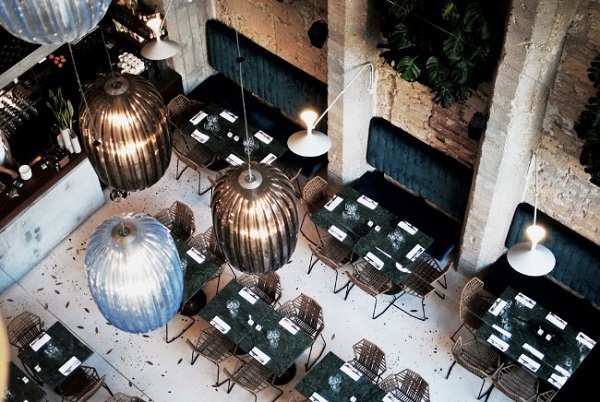
By Hors Limites Architecture and interior designers Francesca Errico and Olivier Delannoy.

Daroco Restaurant, Paris.

My brother-in-law recently came clean at a family gathering that despite his otherwise frugal sensibilities, he is no longer willing to settle for random hotels when he travels (which is often). He finally acknowledged how important a role the room and vibe of a place play in his overall mood and ability to feel sane, happy, inspired — or in other words, himself. 

It’s so true. I feel the same way when I travel, but what disturbs me more are the character-free experiences that I regularly encounter in my backyard. Arguably, in some molecular way, they’re part of the fabric of my life — not something I can swipe past on my HotelTonight app.

It got me thinking. How much does environment affect our mental health — even for short exposures? What about productivity? And, how do we overcome places and spaces that depress us…particularly if you’re in the habit (and business) of enhancing experience/making places and things better/more beautiful/thoughtful/engaging?

I was always taught that it’s not where you are but how you are. I still believe this. But sterile, cookie cutter or otherwise drab spaces make this downright challenging. The nondescript is also a reality. Not every coffee shop can be transformational. Not every conference room can inspire big thinking. Not every errand can be done at an architecturally significant indoor/outdoor retail utopia.

In my own life, I find that when I go to a particular mall, indoor sports facility or big box store – all located on an especially sad stretch of commerce about 10 miles from my house – it creates an acute (but thankfully temporary) mental hiccup. From the moment natural light disappears, I start to panic. I don’t know what it is about those fluorescent lights, industrial carpets and endless gray-beige palettes that seize me, but there’s almost a fear of getting trapped, lost, or worse, that it somehow defines me. It ignites an unfortunate interior dialogue that goes something like this:

Is this (really) my life? What have I done with myself? Am I a suburban shopper? Is this my punishment for leaving the city? Who are these people? What does anything mean? Is that mirror accurate? Should I trade my jeans for more forgiving softpants? Should I buy a beanbag chair? (Answer — no).

Why does being held (voluntarily) hostage inside certain walls scream intervention? I’m guessing it has something to do with the environment being an extension of personal values — and circumstances playing into our idea of ourselves and who we most want to be. This is one thought, but a place can impact people in less obvious ways, too.

My daughter shared that a certain friends’ house makes her anxious and sad (it’s dark, cluttered and often chaotic). Her comment was “I don’t feel like they want me there.” 

Isn’t it interesting how the environment has the ability to create and perpetuate a narrative. Sometimes it’s hard to say why the “ick” feeling appears. I always want to think I’m stronger than any “place” — I mean look at Mandela! But if I’m honest, I’ve been happier in a remote village in India sleeping on a prison cot than at a Footlocker in a strip mall. It doesn’t always make sense.

Is there a place that gets to you? Where you don’t recognize yourself? Where your compass points anywhere but here? And is there a way you could turn it around — and take it back in some useful way?

I think design is the antidote to depression, fatigue, sadness and lots of other maladies. But life doesn’t happen inside a Zaha Hadid ecosystem operated by Soho House.

I’m learning to design those spaces inside myself, as a result of living in a bucolic seaside village that occasionally renders me mall-bound. Having a good sense of humor about what other people consider “designed” is also helpful.

I’ll count this operation as a success once I can swap Chipotle for my favorite spot in Paris, above. Thurs far, it’s still just #goals.

Big Life

Eggshells.

February 13, 2018 · By Amy Swift Crosby

Fragile: delicate, vulnerable. Not strong or sturdy.

It’s hard to fully be yourself in any meaningful relationship when you have to be too careful – when there is even the slightest sensation of eggshells underfoot. Filtering oneself, whatever the degree, is not without cost. What I have noticed though is that eggshells are hard to spot in certain relationships. Crisis has a way of pointing out what couldn’t be seen before.

I once had a friend, a good friend, and business colleague, who played a huge role in my professional development. She brought me into opportunities that would shape my career and life, and over time became a big part of my day-to-day. But as much as I appreciated her support and promotion of my work, she was also unpredictable, emotionally erratic and had a fierce temper.

I learned to live with those edges because I cared about her, felt I owed her, and, logistically speaking, she was enmeshed in multiple aspects of my life. I chose my words carefully and handled myself with caution around her, and it became a dance I perfected. It was only years later that I began to see how much work all the tip-toeing and mind reading took. It’s hard to see the web you’re in when you’re in it. Now I know I was in a constant state of encouraging, soothing, reassuring or dodging bullets –  and it was exhausting.

One day she lobbed a ‘grenade’ over the fence…not only landing on me but on a lot of people in her orbit. It was the direct offensive that finally put the relationship into clear focus for me. Her outburst caused hurt feelings, professional setbacks and general bewilderment all around.

Her extreme actions allowed me to get “out” of a toxic situation, one that had long felt suffocating and fragile, without having to have a conversation. But I had no idea how deeply the dynamic impacted me until one day it was no longer there. I felt lighter and relieved.

I could have had the conversation, drawn the boundary or taken some proactive steps to address the issues more honestly, of course, but it really wasn’t until it was gone that I realized how much I was holding back. I’m not asserting that my approach is in any way evolved, but I do recognize the (very) human need to overlook behavior to save feelings.

Eggshells can cause a version of ourselves to emerge that we don’t much like, that could even feel tense/fake/compromised. I couldn’t see how much I adapted around her until I didn’t have to.

They also exist to signal landmines, even when we don’t know where those explosives are located. We fear stepping on them, at any time, anywhere, and as a result, move toward what feels like a safer trajectory. But in survival mode, we also lose something. Is it genuine expression? Is it truthfulness? Is it an ability to just be ourselves? Is it the opposite of intimacy — in the form of distance and protection?

There’s a difference between being sensitive, considerate and compassionate, and constantly worrying that you’ve ignited or wounded a person in some way. Worse is living in constant anticipation of it.

Knowing that difference can be a guide to the relationships we both cultivate and avoid. And to what we can no longer stand.

Funny thing about an eggshell — you can only remove one — with one.

If this metaphor is lost on you, what I mean is this… difficult relationships often require equally difficult conversations to effectuate change. And challenging dynamics are often only disrupted vis a vis a challenging incident that seems unwanted at first glance, but may be the straw that breaks the camel’s back…or pattern, in this case.

Empathy doesn’t feel exhausting.
Perpetual restraint…does.

Big Life

Hold.

February 6, 2018 · By Amy Swift Crosby

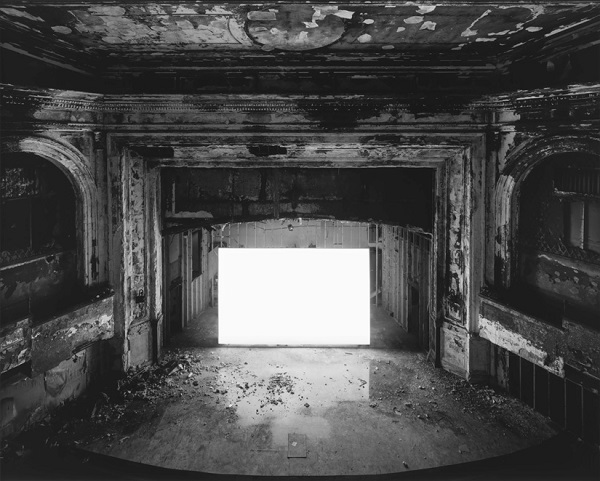
Franklin Park Theater, "Rashomon" 1950, Boston, 2015A, Hiroshi Sugimoto.

Great ideas are tempted by empty stages.

When we hear the popularized term “holding space,” more often than not, it relates to something in the metaphysical sphere. But lately, when I apply the principle more literally, it offers interesting relevance in the real world. It’s especially true when conditions need to change, or the shape of something seems to be asking to evolve into its next incarnation, but I don’t know what to “do” about it.

On most Tuesday mornings, I take part in a morning dance rave at a nearby studio. It’s not a popular offering (yet) and, truth be told, at times I’ve been one of only two people in attendance.

I love the freedom, the darkness, the fact that despite the low headcount, the studio owner still gets up early to host it. Through this weekly event, she and I are both holding space, but in different ways:

She, by opening the doors, putting it on the schedule, turning on the music and turning down the lights; Me, by planning for it, and then showing up.

Taking it one step further, we’re both betting that something good will come from an open-ended question of sorts. With no agenda, only intention, it allows for answers, downloads and insights; about what, we don’t know ‘till we do it.  But it does require some trust and an adjustment of traditional expectations.
If I expected a crowded, mind-bending Burning Man experience that opened the door on a new quantum universe, I might be disappointed. If she expected a packed house and commensurate fees, she’d be equally bummed.

Because we’ve all been there.

You plan, you craft –  roll up your sleeves on a project, service, piece of work — and the applause is light at best, or at worst, inaudible.  Maybe you can point to a variety of reasons why, or not, but the takeaway is the same; zero bodies, dollars, likes, ROI…and seemingly little progress.

But…that’s what’s great about holding space for a thing; It’s an approach that takes time and practice, more than strategy and tactics. It’s adjacent to uncovering the answer, and less direct. But it’s surprisingly effective when you have that luxury to do it.

Taken further, I’m thinking of the people or circumstances you want to enter your life, the new energy, the answer, the opportunity — the right dynamic. Sometimes, all you can do is make room in your mind and schedule for those things to make an entrance – because nothing else seems right / clear / possible. You can take all the proscribed steps as well, and should. But just as meditation is often an exercise in not doing something, holding space is being there with intention and attention to see…what unfolds.

When we “hold”, we invite potential.
There’s stillness in it — that ironically, instigates movement.
It’s not proscriptive or instructed. It requires getting body and mind in one place – off-device, on-alert.

I don’t go into my dance rave asking for ideas, but the very act of free movement, with no teacher, no program or method, invites a certain cascade of thoughts that can form something worthwhile. I can’t predict it nor do I look for it.

It’s a parenthesis — with nothing inside (yet.)

Small Business

Demonstrate.

January 30, 2018 · By Amy Swift Crosby

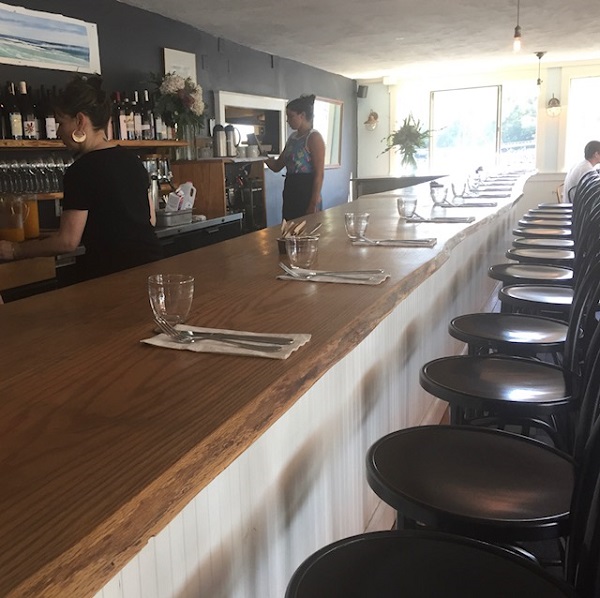
Market Restaurant, Annesquam, MA

The details do the talking.

One of the most powerful things one can do to sell anything, or even to persuade anyone about anything, is to demonstrate. It’s an easily overlooked attribute to marketing because it requires thought, sincerity and is (almost) always more work than slapping a logo on a promotion, or adding exclamation points for emphasis.

It can actually mean less — not more.
It could mean asking the right questions (and listening to the answers.)
Or even sharing best practices as a means of building trust.

None of us likes to be sold to.
Yet, we all enjoy buying into things that speak to us.

Rather than plaster her image on bus stops, a savvy real estate agent differentiates herself with memorable touch points… a thoughtful business card, a tasteful open house sign, and something other than stale supermarket cookies.

A facialist sells by teaching technique, recommending beautification strategies or sharing how to choose a qualified technician. We want her because she doesn’t seem to want anything from us in a business where everyone’s chasing you with a needle.

Taken further, the person who really wants everyone to meditate or take the self-help course, will get everyone interested by being different, not telling us how much we should do it.

In my world, either as a hired creative or as part of a larger agency, we ‘tell’ future clients who we are by the questions we ask and the conversations we start. It is rarely about showing them what we do or how we do it — they can see that with a quick Google search. We need to demonstrate what it might be like to work with us. And how better to do that than to get to know who they are and what they care about? And while it’s not an intentional marketing tactic, it also isn’t pitching in the traditional sense. It is sincere and the right clients remember (and subscribe to it.)

Sure, there are countless outlets for you to pontificate, elaborate, articulate and otherwise proliferate your marketing efforts (thanks for letting me do that.)

But, none will be as effective in attracting the right audience as demonstrating — embodying your message in ways that are seen and felt.

It comes down to this… no one ever wants to be convinced to enroll themselves into anything — products, people, ideas — benevolent cults included.

Be the thing you want us to know. Make choices that reflect rather than project. It’s more of a whisper than a shout.

Big Life

Brrr.

January 23, 2018 · By Amy Swift Crosby

January can often usher in a commitment to do it different or better, even to take on more, but with this drive often comes a dash of existential angst. And, if you happen to experience the winter months in extra cold weather, it can further deepen the crevasse between what you want and what you have, causing you (I mean me) to take a kind of personal inventory.

If you’re reading this, you’ve lived long enough to know that life can be shorter than we might have thought and different than we could have predicted.

The time is now…is a recurring theme.

So it was at about mid-December, amid all the holiday décor, toast-making and reassuring traditions that I started to ask myself…

Am I taking enough risk, or settled and complacent?
Are things vibrant and fierce or muted and dull?
Do I need a cold splash of water over my entire being?

In other words, am I too comfortable?

It occurred to me that I have done the stuff I’m most proud of when I’ve been pretty uncomfortable.

Giving birth.
Climbing mountains.
Facing illness.
Telling the truth.

With sub zero temps outside my window, I don’t have to look far for a little discomfort. Which got me thinking…

Most of us dwell in lives where we’re warm when we want to be, cold when we need to be, fed when we feel like it and distracted…on demand. Assuming chronic pain or crisis isn’t part of your immediate reality, comfort is mostly within arm’s reach.

Which is why any discomfort — physical, emotional – is almost always a shock to our systems, a place we flee rather than seek. Yet, being out of comfort is often precisely what provokes good work that we wouldn’t produce otherwise. I’m starting to think that for as much as I’ve tended to my personal care rituals, there may be equal mileage in finding or embracing some discomfort; withstanding what I don’t think I can stand.

If you follow Wim Hof (whose disciples include Tim Ferris, Tony Robbins and Dean Karnazes) you probably know about ice baths — or at the very least — cold showers. The wisdom behind cold exposure is that our “evolution” has made us less tolerant of the elements, and therefore more susceptible to disease and depression. Our wild, ancient human has been lost. Technically, cold-water submersion is one of a handful of practices that reconditions the hypothalamus to be more adaptive and resilient. The ability to tolerate healthy but difficult environments sharpens the senses and grows capacity, radically changing how we regard our own strengths. All of this, of course, tends to create higher performance. And toughness.

But this isn’t about ice baths or becoming harder. It’s about the dozens of opportunities that already exist in life that have us contracting or flinching, that we discard or escape — thinking they’re bad (at worst) or not useful (at best.) But what if we’re missing an opportunity? What if we could stay in the moment, feel the feelings, witness the unease, hunger, pain, and restlessness — whatever sensation descends – instead of getting out? Why not instead, go in?

Pushing physical (or other) limits to build emotional resiliency is not a new idea, but I like it as a mission, for this year especially, as I take on a fresh set of projects and some realignment on personal goals.

But how do we make the uncomfortable more of a natural habitat?

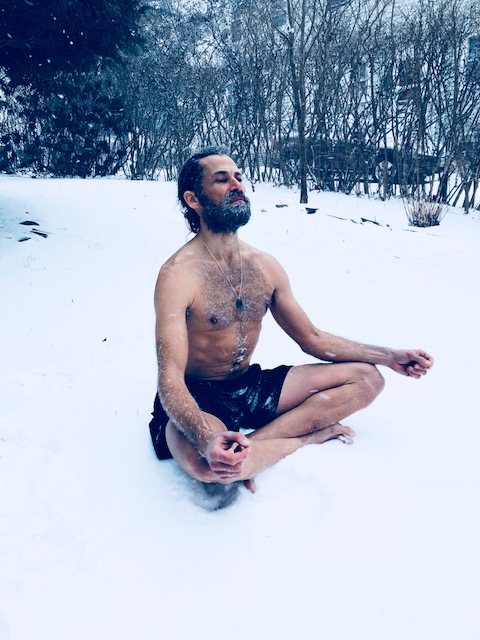
I’m taking cold showers. And I sat in the snow and took 30 breaths in a tank top the other day. I’m resisting the urge to look at my device when an answer eludes me, because I see that it’s an avoidance technique for discomfort. I’m breathing when I feel like clenching. I’m staying in the pose.

Because…

With discomfort comes expansion.
With expansion comes space; it widens the margins, makes more room.

I want that even if my bare feet have to touch the ice to find it. And yes, there are many other ways! But cold has a hold on me. Confronting and embracing it is right outside my door.

Let’s not avoid the things that grip us.
Maybe their existence is the invitation we need to be most awake.

Newer Posts
Older Posts

[insta-gallery id=”1″]

About Me

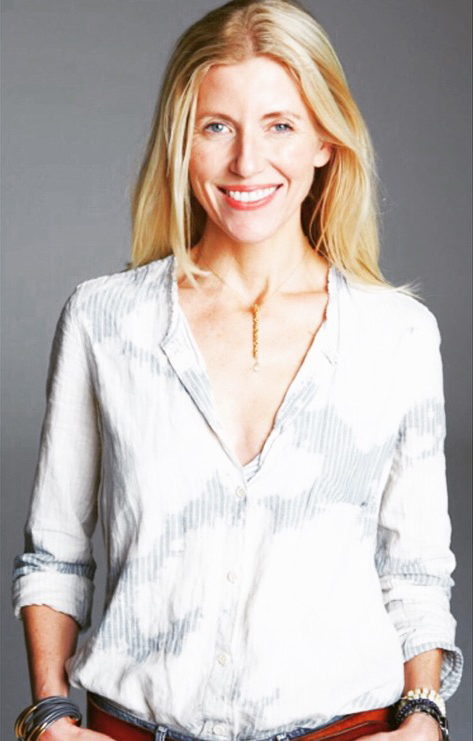
photo of Amy Swift Crosby

I’m a brand strategist and copy writer. I mostly work with partner agencies or directly with the leadership or founding team at a brand. My primary mission is to connect design and messaging solutions to business missions. I work with start-ups and Fortune 500 companies, across beauty, hospitality, wellness/fitness, CPG and retail. This blog reflects my personal writing and explores our humanity – often as it relates to work, space, time and language. You can review my portfolio here or connect with me here.

Photo - Andrew Stiles

The Brandsmiths Podcast


Brand Strategists Hilary Laffer and Amy Swift Crosby tackle business questions with candid, (mostly) serious and definitely unscripted workshopping sessions. Guests – from small business owners to CEOs, executive directors and founders – bring their head-scratchers, hunches and conundrums to Hilary, the owner of a boutique creative agency in Los Angeles, and Amy, a copy writer.

Search Posts


Latest Posts

  • The Last Time.
  • Barefoot.
  • Mileage.
  • Everything.
  • Eddy.


Copyright 2025 Amy Swift Crosby